Wednesday, June 12, 2024

Articulation again - sggmrss 90 part 3. Welcome Mr Samskip.

 Today I stuck on my blue laser printed Samskip container sides and roof from the large sheet of container sides I had printed by a print shop up a long time ago. Some of the sides were pictures of mine and others that I perspective-corrected in photoshop, and some were blatantly stolen from the internet. Something I don't approve of, but at least this is not for any commercial purpose.

As mentioned last time, it's lucky I painted the container ends blue because I forgot my master plan and joined the two halves together before sticking the printed container ends on - In the end I didn't use any printed bits on any of the container 'ends', relying on the blue paint. The printed pieces are on the sides and roofs.

 Overall the wagon looks "OK but not great", maybe a 6 or 7 out of 10.

The thing that irks me about the wagon is that I've made the drop-sides a hair shallower than the plan, and coupled with the tall bogies, the whole thing looks like it sits a little high off the rails. This is something that annoys me about many of the the Marklin wagons, and that I have tried to overcome in most of my previous intermodal efforts... yet seem to have failed to notice here until everything was all but finished. It's quite noticeable against the 2x40-footer next to it in the picture above, although the sides are probably a little deep on this one!
Is this fixable? I suppose I could build new deeper drop-sides, but that seems like a lot of rework, so will likely write it off as a lesson learned. When embedded in the train I suppose it doesn't look so bad. I suppose I could also remove the bogies and the brass articulation assembly and mount them further up inside the wagon. This might be more palatable. We shall see

Now I have 11 or 12 intermodal 'wagons' (counting the articulateds as two). Another two or three would make a decent length intermodal train that would suit the layout. Unfortunately my locomotives won't be able to pull a train of that length up the hill anyway!

Here is my prototype pic for comparison. Maybe with some weathering the high-riding sides will be less noticeable. 
 

Tuesday, June 11, 2024

Articulation again - sggmrss 90 part 2.

This evening I spent an hour or two putting some detail onto the 'wagon sides'. I figured I'd do the same as on the 2x40-footer, so started by putting twistlocks in the corners. D'oh, on 45-foot containers, the twistlocks are inset at the 40-foot mark so that both container sizes can use the same set of twistlocks on a wagon. I should have known that... Rather than rip them off, I just added some extras in the correct places.  These were little cubes cut from .030x.030 inch Evergreen styrene rod.

Some vertical strengthening ribs were added to the deep part of the sides with .010x.020 rod as I had done with the 2x40-footer, which is a lot easier than it looks. 
  • I cut a dozen or more little lengths of the rod oversize and put a tiny puddle of styrene glue on something (like waxed paper).
  • Pick up a little length of rod by the end using tweezers (gently so so it doesn't ping onto the floor).
  • Twist it if necessary so you are holding the rod in the right orientation (I had them so the ribs stick out a wee way(.020) and look skinny from the side (.010)
  • Coat most of a long edge in the glue by dabbing it in the puddle. Avoid getting any glue on the tweezers or the rod will stick to them instead of to the wagon side.
  • Put it in place. If there is not enough glue, you may need to re-dab the rod in the puddle again.
  • Adjust it to be vertical (my built-in 90 degree protractor seems to get less and less accurate each year) and parallel to its neighbours. I decided to to a pair of these ribs at the ends of the drop down and one in the centre - there are loads of different makers and styles of these wagons so this is just "close enough to give the impression of detail." In the real world these are usually placed below the various sets of twistlocks.
  • After they have set, put the outside of the wagon down onto something like a block of wood and trim all the excess pieces of the ribs to be the same length as the sides with a sharp knife.
A base piece along the bottom of these sides was added for strength and looks. I should have continued this up the angled parts as well, but decided it wasn't really necessary. And I was feeling lazy. A few other bits were added over the bolsters, and then a touch of grey paint added.
A little blue was dribbled onto the ends and corners of the containers as an experiment. As you will see in the next edition, I'm glad I did this. The 'easy' end bogies also got attached at some stage. 

It's starting to come together....

Sunday, June 9, 2024

Articulation again - sggmrss 90 part 1.

A long time ago, in a galaxy far, far away, I made a nifty articulated pair of 40-foot wagons - (sggrss part 1 ,  part 2 and part 3). I can't believe that was more than six years ago!

A 40-foot set was built because I had some nice 40-foot American Z Lines (AZL) containers on hand, but I never actually saw 40-foot articulated platforms on the Gotthard, they all seemed to be 45-foot pairs. In the alphabet soup that is European wagon classification, these may be called "sggmrss 90." Here is a picture of one I took at Wattinger a long time ago.

So it seems logical to finally make one of these. Once again, the containers will provide most of the structural strength here, so I began this saga some time ago by (badly) sawing a pair of 40 foot containers in half. I think these came from MicroTrains Z scale American doublestack wagons. They were then stuck back together with some styrene rod inside in an expanded position so they were 45 feet long.

A start was then made on the wagon sides, which will hang under the containers. As I don't have much .040x.040 inch styrene strip left, I used skinny .010x.040 for the long top pieces (and will probably regret that later). The 'drop' parts of the sides were made from .010 x .080 using the plan as a guide for cutting the angles.

I started marking the 'inboard' angles with a fine black marker (as above) on the cut pieces before I realised the inboard and outboard angles were the same, so it didn't matter which end was which!
The drop sides were attached to the thin, long underframe pieces with some backing styrene. Of course it does matter which end is which here, as the drop sides are not centred, but located towards the middle of the articulated wagon to clear two axles on the outer ends but only one with the shard bogie in the middle if that makes sense. It goes without saying that I accidentally made three of one side and one of the other! Fortunately I had cut enough pieces for 8 sides (with a plan to make two wagons before I hit on a smarter way to make these).
Then it was time to attack the bogies, or drehgestell if you prefer. These came from my weird-looking Marklin 82434 Schauffele dump cars that were purchased for their Y25 bogies because they were the least costly wagons available at the time.
The two end bogies are easy to install with their attached frames, but the center bogie has to be popped off and have its mushroom-shaped mounting pin and the coupler removed. Note that the inboard face of the coupler remains, as this helps hold the wheel in.
Then it was carefully drilled for the brass screw (as the bogie is made from that tough, shiny plastic: carefully). Two articulating brass pieces were then prepared which will be attached under the containers.  Although plastic washers (from N scale Microtrains bogies) will be used to separate the bogie away from the brass strips, I shape the lower one to make sure there is no chance the brass will impede the turning of the bogie or cause an electrical short if the wheel flanges touch it. 
This lower piece of brass has been shaped with a file in the picture above. Hardly a work of art, but nobody should ever see it again. A brass screw is used so it can be soldered to the top piece of brass, which has been prepared in the picture below.
Two Microtrains washers were used (rather than one visible here). 
All soldered up. Carefully! The top of the screw was then cut off with a Dremel, taking pauses to prevent everything getting to hot. The whole assembly swivels as it should. Its a little tighter than the 40-foot model, but there seems to be enough play.

Saturday, May 4, 2024

The Pink House


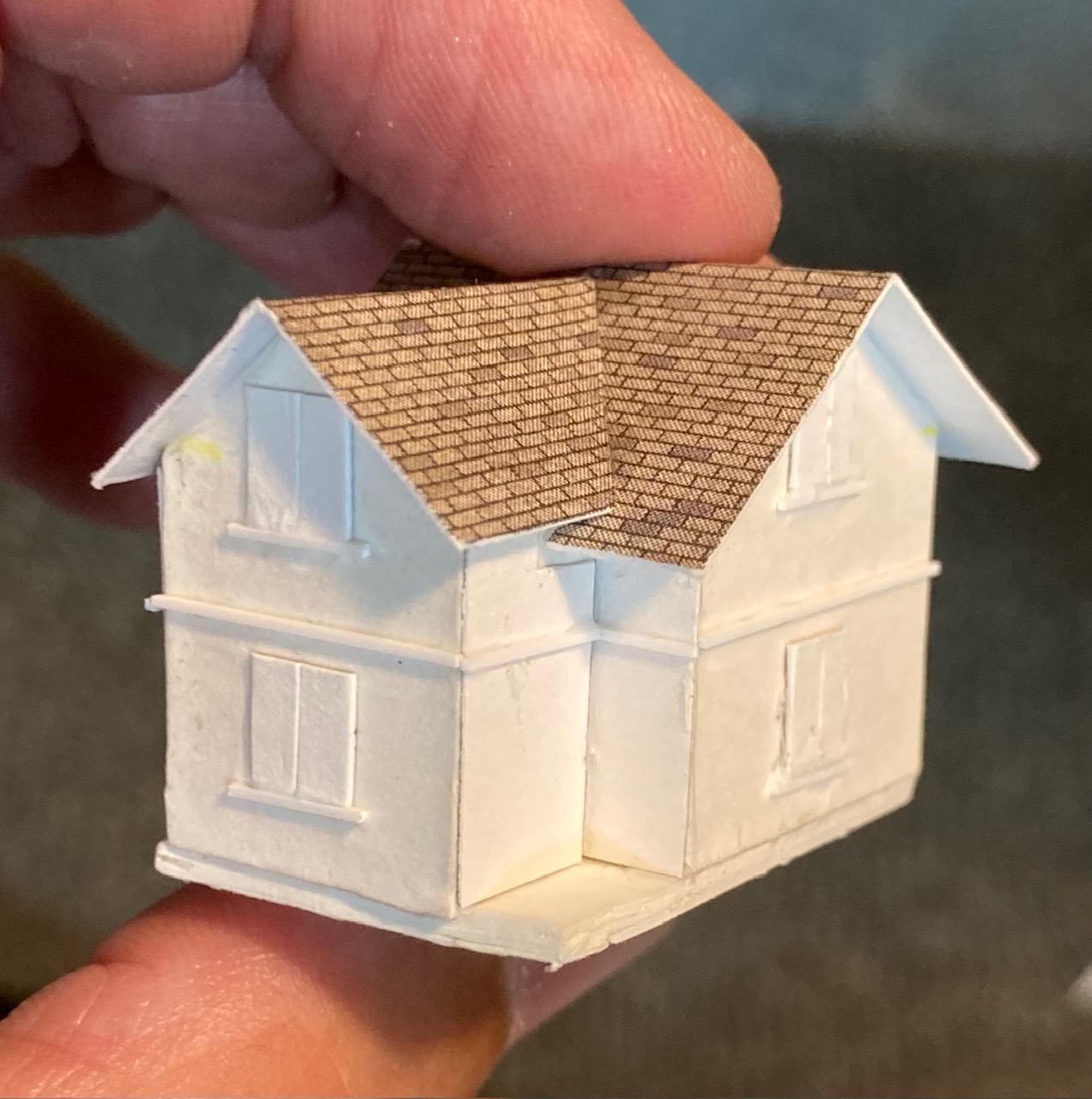
Not much to report this week, other than filling the spot between the service station and the rest of the town with a tiny version of the pinky/red house that lives in the real Wassen.

This is a small space, so the house was and simplified (a lot) and shrunk (a lot) to fit. I probably made it a little bit too small, but the important thing is that it fills the space and more or less completes that quarter of the town.


I'm torn between building another building next or a new wagon...

Saturday, April 20, 2024

Shell Wassen

Today I had a crack at the petrol station alluded to in the previous post, and to my surprise had it glued down within two hours.

The real thing has a wooden upper floor on a concrete block lower, with an angled extension out front that I declined to model, out of both laziness and a lack of space.


For the top half I used some grossly overscale but decent looking faller card sheet, with an overlay of roof-slate-printed Faller card for the bottom concrete blocks. The black bits are for the big windows downstairs.
And overlaid:
The 'concrete block' bits were overpainted beforehand with a light grey so the detail would still show through, and the roof later painted darker, as these were made from the same card material. 
As usual, its all a bit hokey and out-of-square, but it looks OK from a distance.  The canopy sides were painted yellow and some red decal stripes added. I considered putting 'Shell' and Mattli' signs up, but I doubt they would want to be associated with such a crooked model.

Under the canopy are some white pieces of wire poked into the foamboard road and a few bits of plastic rod for petrol pumps. If I wasn't so lazy I would have put some red and yellow on them before sticking them down.

Thursday, April 18, 2024

Wassen Gotthardstrasse

 I intended to make the Wassen Shell service station today.

After making a start on the yellow canopy, some time was spent pondering about how big the building should be, and where it should all be located on the layout. 

To do that it made sense to see where the road goes.

To do that I might as well put down the road. 

To do that I needed to put the sidewalk and buildings down. 

So the (incorrect for Wassen) cobblestone sidewalks went in, almost all the buildings on the far side of the road (except the Alte Poste) were glued down, a little scenery was added behind the gaps, and the road went down. A drill bit is holding down the schoolhouse in a near-vertical position.


The main bits of road on this layout were made from Faller Z Scale crepe roading. But that ran out, and it's hard to get Z scale roads here. Here, I used some larger scale stuff, trimmed the width of the side lines and drew in middle lines with a white pencil. This was then extended up towards the right side of the layout, tapering a little at the far end under the church, as that will be hidden by buildings and trees.

The Shell station canopy is the triangley bit. With the roads and basics in place, I can start adding soem more buildings. Starting with the Shell, and probably the obvious pink building in between it and the existing buildings.

As an aside, I see the Alte Poste hotel shut down in 2019 and was for sale. It seems silly, but I expect that a lot of their trade was railfans, so they can probably blame the BasisTunnel for there now being too many rooms in Wassen.

Wednesday, April 10, 2024

Obere Wattinger Fin


Two outstanding items in the transformed Upper Wattinger corner were some piers/supports for the road bridge, and the little house/track maintainers house/signal house/I'm not sure what these are, but they are littered around the trackage at Wassen.

This hut was made out of some thick white cardboard that was lying around.

A bit of artistic license was employed to have it fit the space available. 

This end (that everyone sees in pictures of the real thing taken from the road) should have a different roof profile and be wider, but had to be condensed to fit the space.

I had a pic of it on my computer and thought it had yellow window shutters and red/orange window sills, so this is what I did, but those bright colours stood out and drew too much attention. 

I pondered this overnight and found another picture with light green shutters and grey sills, so today I recoated these items and it looks a bit more subtle. I don't want any of the horrible bits of the layout (all of it really) to stand out and kick you between the teeth, I'd rather have the trains be the eye-catching elements.

I also painted the 'wooden top floor' parts of the house as it appears in photos. This makes the place look a bit more interesting and less stark white.


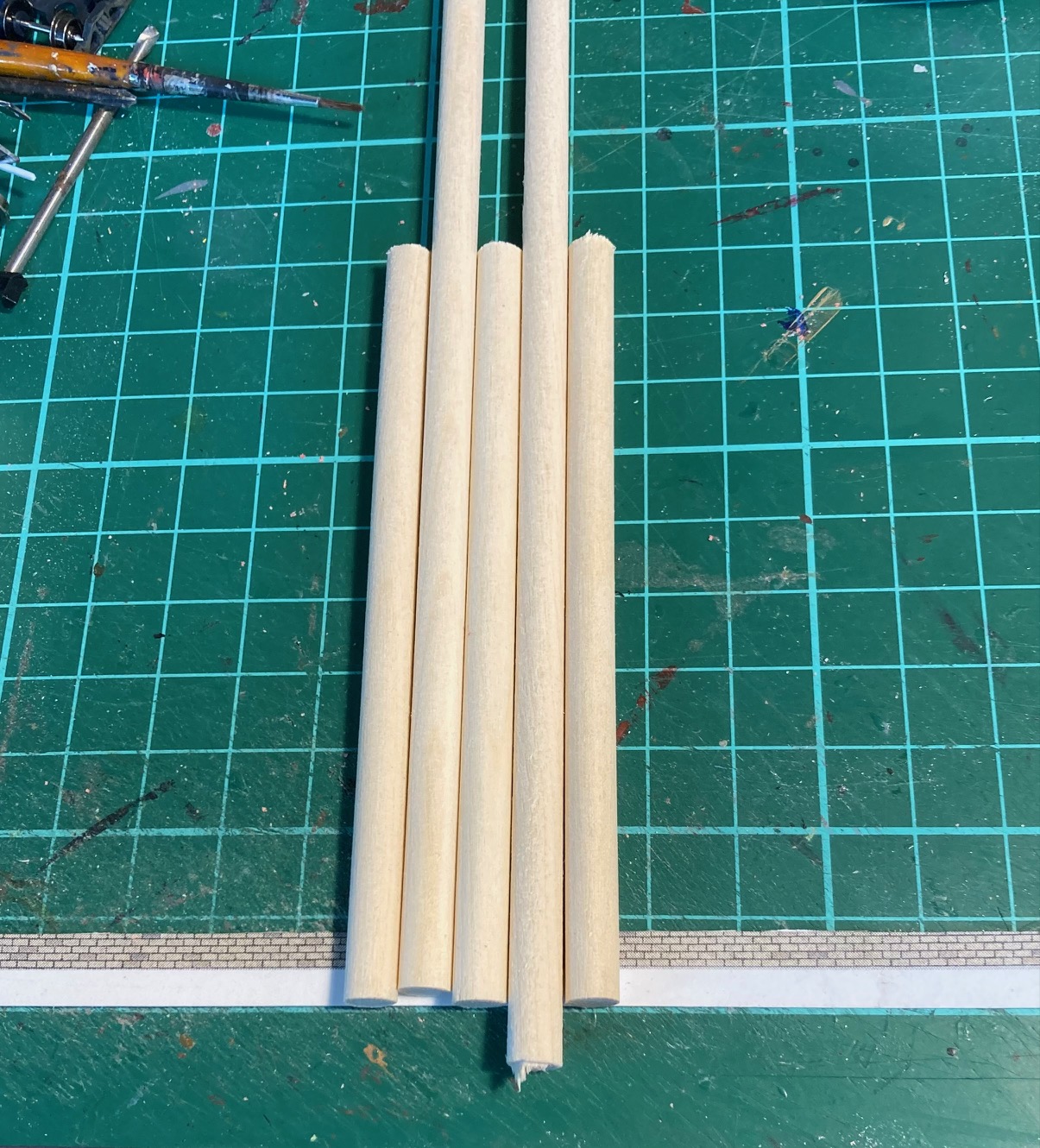
As for the bridge piers, I was looking for something with a rectangular cross section to make two columns out of, but unfortunately we don't have a lot of hobby supplies in our town. Then I thought why not use drinking straws. These might have buckled and gotten out of alignment, but even before that fear had entered my tiny mind, I was passing through a local dollar shop when these wooden dowels jumped out at me. Perfect. 

I cut three sections to fit under the road bridge and used two of the (longer) offcuts as spacers between the columns to keep everything separated and parallel while the whole pier was assembled. The three short pieces were glued to a thin strip of card...

And then the card was folded around to form a 'capping' piece. The attaching was done with PVA wood glue, making sure not to get any glue on the spacers. As seen here under a glass of water that was being used to hold the card down while the glue sets: 

The spacers were then pulled out and discarded, and the 'structure' painted with a mix of greys that looked concretey. The piers were glued in and some rocks placed around the base:


The house hasn't been glued down and scenicked yet.